AI Agents for Business-Critical Processes
Document Agents. Workflow Agents. Knowledge Agents.
Specialized AI agents that read documents, orchestrate processes, and deliver context-based answers from enterprise knowledge. Every agent operates within a Decision Layer that makes every decision transparent, auditable, and traceable.







Building an agent is easy. Making it enterprise-ready is not.
Workflow agents can be prototyped in days. ChatGPT, Claude, or Llama - an agent that reads documents and generates answers is no longer a technical challenge.
The real problem starts afterward: Is the agent's decision auditable? Does it meet EU AI Act requirements (transparency, human oversight, recording obligations)? Can employee representation bodies trace the rules the agent follows? Does the architecture withstand a SOC 2 audit?
That is exactly where we come in. Not building the agent itself - but the governance layer that makes it production-ready, auditable, and certifiable. If you plan governance after the PoC, you build twice.
The Core Problem in Enterprises
Enterprise processes rely on the implicit knowledge of individual employees. Collective agreements, company policies, posting logic, compliance rules - a complex rule set whose application varies from person to person.
The consequences: inconsistent decisions across locations, errors that only surface during audits, knowledge loss during staff turnover, and processes that do not scale because they depend on individual people.
Decision Quality, Not Process Automation
Enterprise decisions are formally human, but often inconsistently documented. An AI Agent does not replace domain decisions. It structures them, documents them, and makes them reproducible. The goal is not automation for its own sake, but consistent, traceable decision quality across all locations and case workers.
Three Agent Types
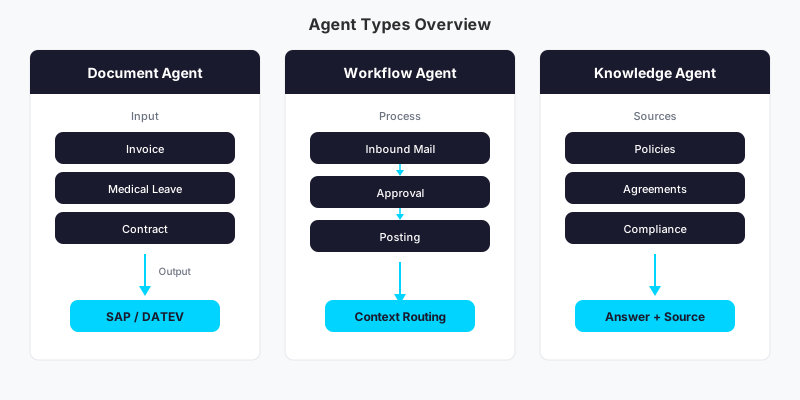
1. Document Agents
Document Agents read, understand, and process documents with genuine language comprehension. No template recognition, no rigid OCR rules - contextual understanding of content.
What they process: incoming invoices and credit notes, sick notes and medical certificates, employment contracts and amendments, certificates and attestations, receipts.
Document    →  Agent reads    →  Decision Layer checks
(invoice)      and understands   completeness, plausibility,
                                  tax classification
                                       │
                          ┌────────────┴────────────┐
                          │                         │
                   High confidence           Low confidence
                   Rule clear                or exception
                          │                         │
                   Posting proposal          Escalation to
                   + audit trail             specialist
The Document Agent does not replace specialists. It processes routine cases autonomously and escalates exceptions to humans - with complete documentation.
2. Workflow Agents
Workflow Agents orchestrate processes across systems. When a document must be read, a decision made, and an action triggered in a target system - the Workflow Agent coordinates the entire flow.
Example workflow: Sick note

Incoming     →  Document Agent  →  Decision Layer
(email with     reads sick note    checks entitlement
 attachment)    and extracts       and policy constraints
                data                    │
                           ┌────────────┴────────────┐
                           │                         │
                    Compliant                 Query needed
                           │                         │
                    Calculate                 HR specialist
                    continued pay             is notified
                           │                         │
                    Propose SAP              Waits for
                    booking                  decision
                           │                         │
                    Audit trail              Audit trail
                    documented               documented
Every step is logged. Every decision is traceable. On queries or missing information, the workflow pauses - it does not abort.
3. Knowledge Agents
Knowledge Agents deliver context-based answers from enterprise knowledge. Company policies, collective agreements, governance frameworks, compliance rules, FAQ catalogs.
Important: Every answer includes its source and rule version. A Knowledge Agent does not answer a question without citing a source. With missing or contradictory rules, it does not answer but refers to the responsible department.
Example: Question: "How many days of special leave do I get for moving?"
Answer: "According to Works Agreement WA-2024-007, Section 3 Para. 2 (Version 2024.2, valid since 01.04.2024), you are entitled to 2 working days of special leave for moving. For employees covered by the collective agreement, Section 29 TV-L additionally provides 1 further day."
Source included. Rule version documented. In case of interpretive ambiguity: referral to HR.
How AI agents work architecturally - MCP, A2A, multi-agent systems, and which platform to orchestrate them on - is covered in the Agent Guide of our Blueprint 2026.
Working Together: Three Agents, One Process
In practice, the three agent types work together. A Workflow Agent orchestrates the overall process and calls Document Agents and Knowledge Agents as specialists when needed.
Example: Sick Note End-to-End
- Document Agent detects the sick note in the email inbox, extracts the employee name, period, and diagnosis code.
- Workflow Agent checks the HR system: is this the third notification within six months?
- Knowledge Agent is called: "At what threshold does the BEM reintegration requirement apply under the current collective agreement?"
- Workflow Agent evaluates the answers: BEM threshold not reached - standard process applies.
- Decision Layer checks statutory constraints and works agreement requirements - calculate continued pay.
- Workflow Agent creates the SAP posting proposal, notifies the HR manager, and documents everything in the audit trail.
Six steps, three agent types, three systems - one continuous audit trail.
How AI agents work architecturally - MCP, A2A, multi-agent systems, and which platform to orchestrate them on - is covered in the Agent Guide of our Blueprint 2026.
Decision Layer
The Decision Layer is the central governance component. It sits between agent and target system, making every LLM decision transparent, auditable, and traceable.
What it checks: professional rule sets, model confidence score, decision risk score, governance framework constraints (collective agreements, works agreements, or company policies), bias and discrimination potential.
What it produces: complete audit trail entry per decision, input hash for reproducibility, rule version per applied rule, routing decision (autonomous or Human-in-the-Loop).
Integration
AI agents do not replace existing systems. SAP remains ERP. Workday remains HCM. DATEV remains tax system. Agent logic is decoupled from the target system.
- SAP FI/CO, SAP S/4HANA
- SAP SuccessFactors
- Workday
- DATEV
- SharePoint, Microsoft Teams (via Microsoft Graph)
- Additional systems via REST/SOAP interfaces
Model Agnosticism
The architecture is not tied to a single LLM. The Model Layer is interchangeable:
- Claude (Anthropic) - currently strongest model for complex text analysis
- ChatGPT (OpenAI) - broad range of applications
- Gemini (Google) - deep integration with Google services
- Llama (Meta) - open source, self-hosted possible
- Mistral - open source, EU-based
- DeepSeek - open source, cost-efficient
- gpt-oss (OpenAI) - open source, self-hosted possible
When a new model becomes available, it can be integrated without changing the business logic. No vendor lock-in to a single model.
Our engineers are certified for Azure AI and cloud-native architectures. We deploy agents on Azure, GCP or your own infrastructure - model-agnostic and platform-open.
Business Impact
- Routine cases processed autonomously - with complete documentation
- Exceptions escalated to humans - with context and recommendation
- Consistent rule interpretation across all locations
- Every decision traceable for auditors and employee representation bodies
- Scalable without proportional headcount increase
- Knowledge stays in the system - not in individual people
Source Code Access and Exit Strategy
Full access to the source code, all prompts, and all rule sets. Configurations and rule sets remain with you. After 12 to 18 months, you operate your agents independently. No vendor lock-in.
Gosign enables independent operation - maintenance is optional, never mandatory. No SaaS subscription, no platform lock-in. You pay for engineering and knowledge transfer, not for dependency.
Deep Dive in the Agent Briefing
Our article series for decision-makers implementing AI agents in the enterprise.
Frequently Asked Questions about AI Agents
What data leaves the company?
None. Agents run in your infrastructure - cloud, self-hosted, or hybrid. With cloud LLMs, the respective provider's DPAs apply. With self-hosted models, no data leaves your network.
How long does a pilot project take?
4-6 weeks to a productive PoC. Discover (1 week), Build (3-4 weeks). The first agent runs live in your infrastructure with Decision Layer and audit trail.
Is this compliant with employee oversight requirements?
Yes. Human-in-the-Loop as architectural principle, complete logging, role concept, audit trail. Governance frameworks - collective agreements, works agreements, or company policies - are mapped as explicit constraints in the Decision Layer. Built for the most demanding regulatory environment globally - German co-determination law, EU AI Act, and GDPR - meeting or exceeding compliance requirements in virtually any jurisdiction.
Which models are used?
The architecture is model-agnostic. Currently: Claude, ChatGPT, Gemini, Llama, Mistral, DeepSeek, gpt-oss. Models are interchangeable without changing the business logic.
How do the three agent types work together?
A Workflow Agent orchestrates the overall process and calls Document Agents (for document processing) and Knowledge Agents (for rule-set queries) as needed. Each agent has its own Decision Layer, and the Workflow Agent coordinates results across system boundaries.
Deep Dive
Enterprise AI Infrastructure Blueprint 2026
From chatbots to AI agents: MCP and A2A protocols, multi-agent systems, agent orchestration with Trigger.dev and Camunda - and how the Decision Layer ensures control.