EUR 53 per case
Expense tools digitise paper forms. The employee fills in, the manager approves, accounting reviews. Three manual steps, EUR 53 each (GBTA, 2024). At 100,000 cases per year, that is EUR 5.3 million in processing costs alone.
EUR 53 per case. 19% error rate. A structural problem.
The AI Agent classifies receipt type, country assignment, and tariff application. Reimbursement amounts, per diems, and tax allowances are calculated deterministically by the rule engine. Every decision documented, reproducible, audit-proof.







per case, manual processing
error rate in travel expense reports
correction cost per error
GBTA Foundation 2024: USD 58 per transaction (approx. EUR 53).
The Problem
SAP Concur, Circula, Moss, Spendesk. They all digitise the same manual process: capture receipts, fill out forms, obtain approvals. At EUR 53 per case and 19% error rate according to GBTA, that is expensive. But in organisations with collective agreements, international staff and dozens of legal jurisdictions, capture is not the problem. The decision is.
Expense tools digitise paper forms. The employee fills in, the manager approves, accounting reviews. Three manual steps, EUR 53 each (GBTA, 2024). At 100,000 cases per year, that is EUR 5.3 million in processing costs alone.
Country-specific per diems, posting rules, meal deductions, collective agreement overrides, tax exemption thresholds. No employee knows all the rules. No approver checks them. Result: one in five cases is incorrect. EUR 48 correction cost per error (GBTA, 2024).
When the tax auditor arrives, the evidence is missing: which rule was applied? Why this per diem? Was the deduction correct? Expense tools document what was submitted. Not why it was decided that way.
The Decision Layer
The Travel Decision Layer works like every Gosign Decision Layer: it decomposes a process into individual decision steps and defines for each step who or what decides. Rule engine, collective agreement, or human. Not everything at once, but step by step, documented and traceable.
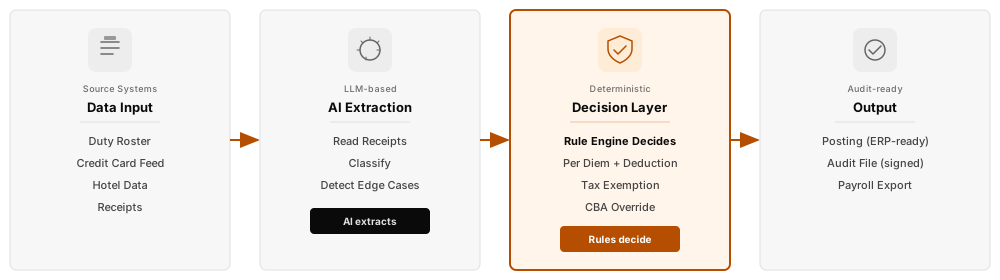
AI extracts and classifies. The Decision Layer decides. This separation is the reason the system is auditable, AI Act compliant and employee-representation compliant.
Decision tables are versioned. Every case is checked against a defined rule version. The AI Agent classifies, the rule engine calculates reimbursement amounts, per diems, and tax allowances deterministically.
Not one big decision 'approved / rejected', but dozens of small ones: which per diem? Which deduction? Which collective agreement? Tax-exempt portion? Each individually documented.
The Decision Layer does not decide everything itself. It knows which steps the rule engine covers, which are defined by collective agreements and where a human must intervene. The result: only genuine exceptions need human attention.
Traditional expense tools ask the employee to confirm their own expense report. The Decision Layer reverses this: processing happens automatically. The employee is informed and has a veto right.
Governance
When the tax auditor asks "Why was 28 EUR applied instead of 14 EUR?", "the system calculated it" is not sufficient. The Travel Decision Layer generates a decision record for every case that answers exactly this question: which rule, which input, which result, when, by whom.
Append-only. Nothing is overwritten, nothing deleted. Corrections create reversal and adjustment entries. SHA-256 signed, exportable at any time.
Rule set inspectable. Decisions traceable. Anomaly scoring controllable via feature flag. Reports pseudonymised. Compliance and performance architecturally separated.
Co-determination →Retention periods supported (10 years in Germany, varies by jurisdiction). Anonymisation instead of deletion for GDPR compatibility. Every case reproducible via input hash.
Cert-Ready →Not a quarterly report, not a sampling check. Every single case is rule-checked. Deviations are flagged immediately, not discovered months later during reconciliation.
| Dimension | Travel Decision Layer | Traditional Expense Tool |
|---|---|---|
| Decision model | Decision Layer applies rules, human has veto | Human fills in, manager approves |
| Rule complexity | Versioned decision tables: tax rules, per diems, collective agreements | Basic policies, no collective agreement logic |
| Audit trail | Every micro-decision documented: rule, input, result, timestamp | Receipt stored, decision not documented |
| Tax audit | Export: sealed audit pack per case, reproducible via input hash | Manual reconstruction from files |
| Employee experience | Automatic processing, notification, veto option | Form, upload, wait for approval |
| Scalability | Constant: 100 or 100,000 cases, same rule engine | Linear: more cases = more reviewers |
| Works council / employee representation | Rule set inspectable, anomaly scoring controllable via feature flag, reports pseudonymised | Opaque, difficult to audit |
Simulated for enterprise volumes
We configured the Travel Decision Layer for four industries with realistic volumes and calculated the results. Each card shows the simulation parameters and outcome.
Implementation
The Travel Decision Layer runs entirely within your infrastructure: your data centre, your network, your control. No SaaS dependency, no data leakage, no external telemetry tracking. Containerised, multi-tenant, deployment-ready for your private cloud or as managed deployment in EU data centres. (US: US-based hosting is configurable for US-only deployments.)
The Decision Layer is not installed but configured: your collective agreements, your policies, your system landscape. Typical pilot projects start within 3 months with one industry and one collective agreement. Extensions to additional staff groups or system connections run in parallel with pilot operations.
Systematic rule checking instead of sampling
Every case goes through the same rule engine. Deviations are flagged and documented, not discovered during quarterly reconciliation.
No approval workflows for standard cases
Throughput time from days to minutes. Managers only approve exceptions.
Automatic cost centre and project assignment
No manual mapping for thousands of cases. No month-end bottleneck.
Audit-proof decision records created within the process
Tax audit is an export, not a research project. Weeks become minutes.
Security
Not retrofitted as a feature, but built as an architecture principle. The Travel Decision Layer is designed for regulated environments where data protection, audit readiness and traceability are not optional extras.
The Decision Layer runs entirely within your network. No SaaS dependency, no data leakage, no external telemetry tracking. Secrets in your KMS, logs in your SIEM, SSO via your identity provider. (US: US-based hosting is configurable for US-only deployments.)
Anonymisation instead of deletion. Compatible with tax retention periods and GDPR Art. 17. No conflict between tax law and data protection. (UK: UK GDPR provisions apply equivalently post-Brexit.)
Data residency in detailClear architecture separation: LLM for data extraction, Decision Layer for decisions. No black box over tax matters. Every decision reconstructable.
EU AI Act ReadinessSigned decision records. Input hash plus rule version yields reproducible result. Sealed audit packs (JSON + PDF, SHA-256). Tax audit ready at any time.
Integrated controls registry, automated evidence runs, versioned policies. Compliance in running operations, not documented after the fact.
Cert-Ready by DesignIntegration with existing identity providers. Tenant isolation at database level (row-level security). Role model granularly configurable.
Our article series for decision-makers implementing AI agents in the enterprise.
Concur is a capture and workflow tool. The employee fills in a form, the manager approves. The Travel Decision Layer is a decision layer: it decides deterministically based on rule engines, documents every decision and generates audit-proof decision records. Concur digitises the paper process. The Decision Layer replaces it.
No. The Decision Layer sits between source systems and ERP. It reads data from duty rosters, credit card feeds and receipts, makes decisions and delivers posting-ready results to SAP, Oracle, or any ERP system.
Collective agreement rules are configured per client project. The Decision Layer can map collective agreement per diem rates that override statutory rates. The mapping of your specific collective agreement logic is developed together during implementation.
Decision tables are versioned. New rule sets are deployed as their own version, with a validity period. Retroactive changes trigger automatic recalculation. No entries are overwritten: the Decision Layer creates reversal and adjustment entries. The complete history is preserved and traceable at all times.
Yes. Every decision is auditable, the rule set is inspectable, and the complete audit trail is accessible to employee representation bodies. Anomaly scoring is controllable via feature flag. Reports are pseudonymised by default. Compliance analysis and performance monitoring are architecturally separated. The Decision Layer makes no opaque AI decisions - it applies documented rules.
We configured the Decision Layer for four industries with realistic parameters: staff volumes, collective agreements, jurisdictions, typical case structures. The zero-touch rates show what proportion of cases can be processed fully automatically. In an initial call, we calculate with your parameters.
In a 30-minute call, we clarify your parameters: volumes, collective agreements, system landscape. From this, a pilot proposal emerges: one industry, one collective agreement, one data flow. Typical pilot projects start within 3 months. Extensions run in parallel.
None. The Decision Layer runs entirely within your infrastructure. No SaaS dependency, no data leakage, no external telemetry tracking. Secrets in your KMS, logs in your SIEM, SSO via your identity provider. (US: US-based hosting is configurable for US-only deployments.)
30 minutes. Your parameters, your volumes, your result. We configure the Decision Layer with your real-world scenarios and show what adds up.
Book a call